
BCP Council forecasts a £27m overspend, 'a real threat' to its financial sustainability. Non-essential spending stopped in July; Cabinet meets 2 September.
BCP Council expects to overspend its budget by £27m this financial year. Its own finance officers describe the forecast as “of a level unseen at the Council” and “a real threat to the financial sustainability of the council”.
The figures are in the quarter one budget monitoring report going to Cabinet on Wednesday 2 September at 10.15am. The meeting is public.
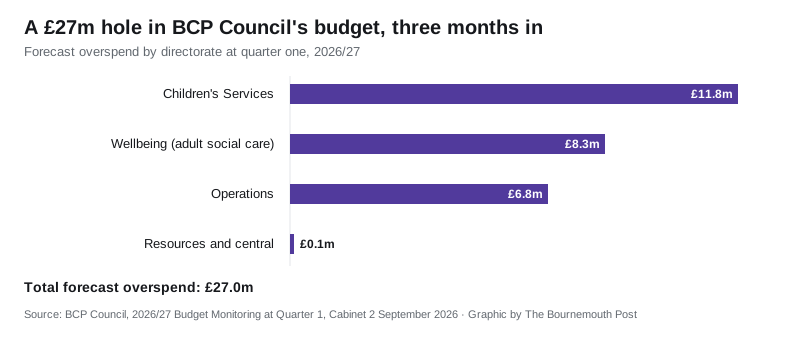
Councillors set a net budget of £452m in February. Three months into the year, the forecast gap is driven almost entirely by social care demand and by income the council expected but is not getting:
- Children’s Services: £11.8m over. The biggest single pressure is children in care and care experienced young people, forecast £17.1m over budget on its own, partly offset by underspends elsewhere. This is £2.7m worse than last year’s outturn despite a £9m budget increase.
- Adult social care: £8.3m over. Rising demand and costlier care packages, particularly for older adults and people with learning disabilities, autism and complex needs.
- Operations: £6.8m over. Parking income is running about 7% below budget, a £3.2m shortfall, and the seafront is £1.1m down as visitors spend less on catering, beach huts and arcades despite strong visitor numbers.
The rest of the council is close to budget: Resources and central budgets are together just £0.1m over, taking the total to £27.0m.
The council is also £4.5m behind on the £14.1m of savings it promised in February’s budget. Most of that gap sits in Operations, where parking and beach hut income proposals have not been delivered.
Spending has been in a “Red” lockdown since 20 July
The scale of the forecast prompted the council’s finance chief to escalate to a “Red spend control environment” on 20 July, the highest level of internal restriction. According to the corporate recovery plan, that means:
- all non-essential spending stopped, including travel, conferences, hospitality, catering and non-mandatory training
- every purchase order above £2,000 now needs a service director’s approval
- most council purchasing cards suspended
- recruitment and agency staff need sign-off from both the Chief Executive and the finance chief
- overtime must be authorised before any hours are worked
- a review of vacant posts to decide which can be deleted
A recovery programme is working through five themes: headcount, income, estates, debt recovery, and contracts and commissioning.
The cushion is thin. The council holds £29.3m in unearmarked reserves, barely more than the forecast overspend itself, and its earmarked reserves are already planned to fall from £48.8m to £42.2m this year.
The £275.5m schools deficit behind it all
The report is blunt that the council’s biggest financial risk is not this year’s overspend but the Dedicated Schools Grant deficit, built up from years of spending on special educational needs support beyond what government funding covers. That deficit stood at £179.8m in April and is forecast to reach £275.5m by March 2027.
The government has offered a lifeline: a High Needs Stability Grant covering 90% of the deficit as it stood in March 2026. It is conditional on ministers approving the council’s SEND Reform Plan, which was submitted in June. If approved, the grant would be paid this autumn.
It was this SEND deficit that persuaded the government to let BCP raise council tax by more than the normal cap this April. Bournemouth’s Band D bill went up even after the council asked for a bigger rise than it was given.
What it means for you
No resident will see a bill change from this report. What changes is the pressure behind every council decision for the rest of the year. Services are being run under the tightest spending controls the council has, and the recovery plan’s income theme means fees and charges, including parking, are explicitly on the table for “maximising”.
There is one piece of good news buried in the papers. Three BCP neighbourhoods, Boscombe West, West Howe, and Hamworthy West and Turlin Moor, have each been allocated up to £20m over ten years from the government’s Pride in Place Programme, with residents deciding how it is spent. We reported on the West Howe neighbourhood board when it was announced.
Cabinet is asked to note the position and to recommend that full Council approve moving £4.36m into central contingency to help absorb the overspend. That is £2.16m of extra housing grant from the final government settlement, plus £2.2m budgeted for borrowing repayments that are not needed this year. The next check on the numbers comes with the quarter two report in the autumn.
Have your say